
Userspace
Userspace programs are ordinary std Rust binaries with a main(). They target
x86_64-unknown-edos and link a forked Rust std, so String, Vec, std::fs,
std::thread and std::net are all there and mean what you expect.
That is the point of the fork: no #![no_std], no custom C library, no bespoke entry
macro.
What ships
Section titled “What ships”128 binaries land in /bin. The shell and the modal editor install under their
short names, sh and vi, though their crates are edos-sh and edos-vi:
Session: edos-init, svc, edos-wm, edos-taskbar, edos-terminal, edos-files,
sh, vi, edos-procview
Coreutils: cat, cp, mv, rm, mkdir, rmdir, ls, ln, touch, stat,
file, head, tail, wc, cut, tr, sort, uniq, tee, grep, sed, diff,
find, du, df, dd, xargs, seq, yes, true, false, echo, env,
printenv, basename, dirname, which, sha256sum, hexdump, cal, date, sleep,
sync, tar, gzip, gunzip, less, id, whoami, mkfifo, hello
System: ps, pstree, top, kill, free, uname, nproc, dmesg, mount,
lsof, pmap, watch, strace, write, shutdown, keymap, efs-mkfs, fsck,
edos-install
Network: ping, dns, dnsprobe, http, wget, nc, netstat, httpd,
tcpecho, sntp, sshd, lookupd, a caching name lookup daemon that every program
reaches without being rebuilt, and edos-web, a browser: an address bar,
history, links and fragments, CSS, images and tables, laid out in a window
Media: play, which pushes WAV data at /dev/dsp, and imgview, which reads PNG,
WebP, JPEG, BMP and SVG
Packages: grab, the package manager, and edos-grab, its graphical front end.
The graphical editor edos-edit is the first program that ships through them rather
than in the image: it is built in this tree like everything else, but published to the
repository instead of installed to /bin.
Screen: screenshot, which writes the framebuffer to a BMP. A pointer the display
holds on its own cursor plane is not in the framebuffer, so a capture says which kind of
pointer is on screen.
Profiling: profile, which samples every CPU from the timer tick and writes the
addresses out for the host to resolve. It cannot see code running with interrupts
disabled, which is the whole kernel heap and the frame allocator, so it is one of two
instruments rather than the instrument.
Games: snake
Tests: alloctest, forktest, exectest, killtest, threadtest, iotest,
mmaptest, evicttest, inflighttest, lockordertest, lookuptest, pitest,
tcptest, vectest, wintest, fstest, sigtest, socktest, stdtest,
orphantest, syscallfuzz, auxvtest, fputest, texttest, fbtest, filetest
Three of those exist because a program that compiles is indistinguishable from a program
that works until something runs it. texttest pipes fixture input through the nine text
coreutils and diffs each against an expected string; filetest does round trips through
tar, gzip, gunzip, ln and tee, since an archive that lists and extracts to the
bytes that went in is what catches an option read as a filename; fbtest asks the
/dev/fb ioctls for more bytes than they were given, which they used to answer.
Benchmarks: fsbench for the filesystem, switchbench, latbench, balancebench
and pollbench for the scheduler and poll paths, allocbench for the userspace heap,
termbench for the terminal widget with no window and no compositor behind it
The test programs are the regression suite, not demos. syscallfuzz reads the call
table out of /proc/syscalls and drives every entry in it with poisoned arguments, so
it covers a syscall added after it was written without being touched; it found two
kernel panics the day it was written.
The shell
Section titled “The shell”edos-sh is a scripting language, not a command dispatcher: functions, control flow,
$(( )) arithmetic, globbing, heredocs and job control. Blocks end with end, so there
is no fi, done or esac.
#!/bin/shfor file in $(ls /bin) if [ -f /bin/$file ] echo "program: $file" endendJob control is real. Each pipeline gets its own process group and the terminal goes to
whichever is in the foreground, so Ctrl+C on sleep 30 | cat kills both stages.
Full reference: Shell scripting.
The file manager
Section titled “The file manager”edos-files makes the desktop usable without a shell: browse, open, rename, delete, make
a folder. A .bmp or .svg opens in imgview, text in the editor.
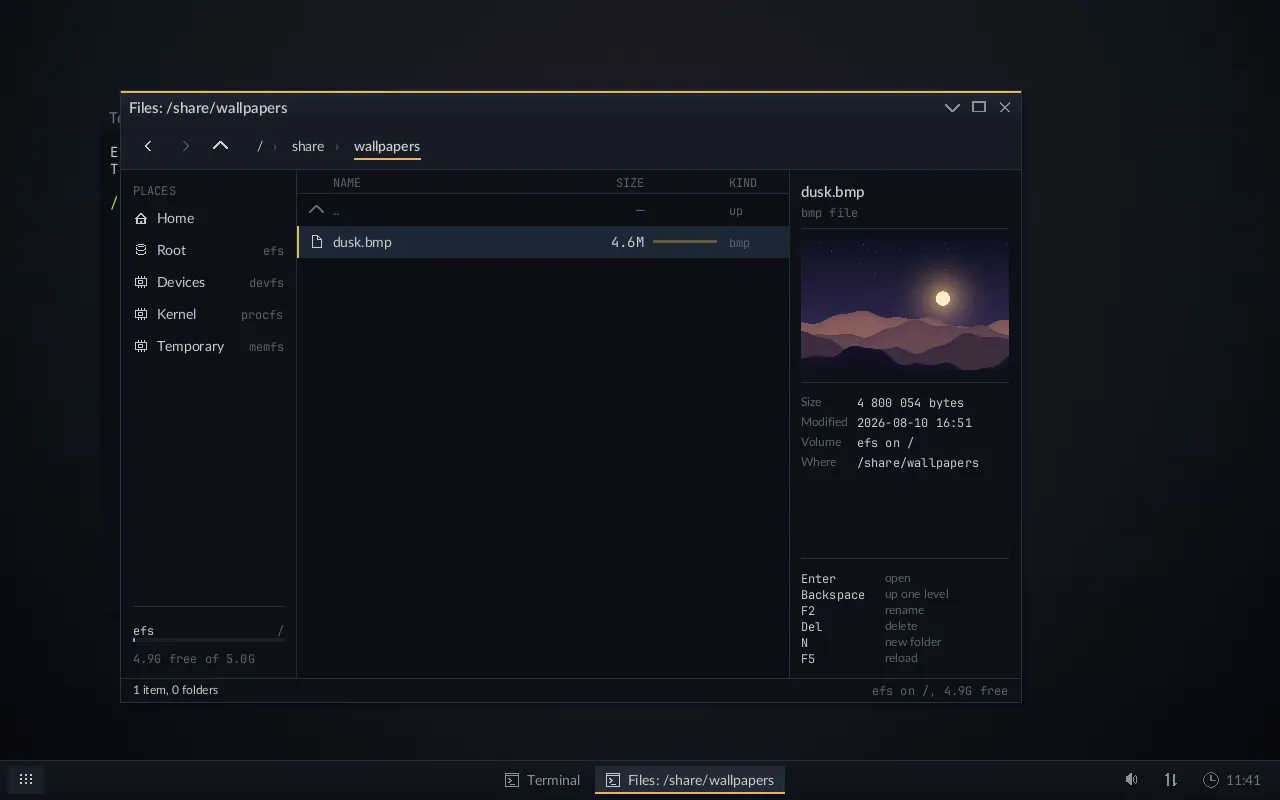
The places rail is the kernel’s mount table, not a favourites list, so it can only offer
somewhere that exists. The meter under it describes the volume you are standing in:
efs on /, 4.9G free, or memfs on /tmp, in memory, forgotten on reboot.
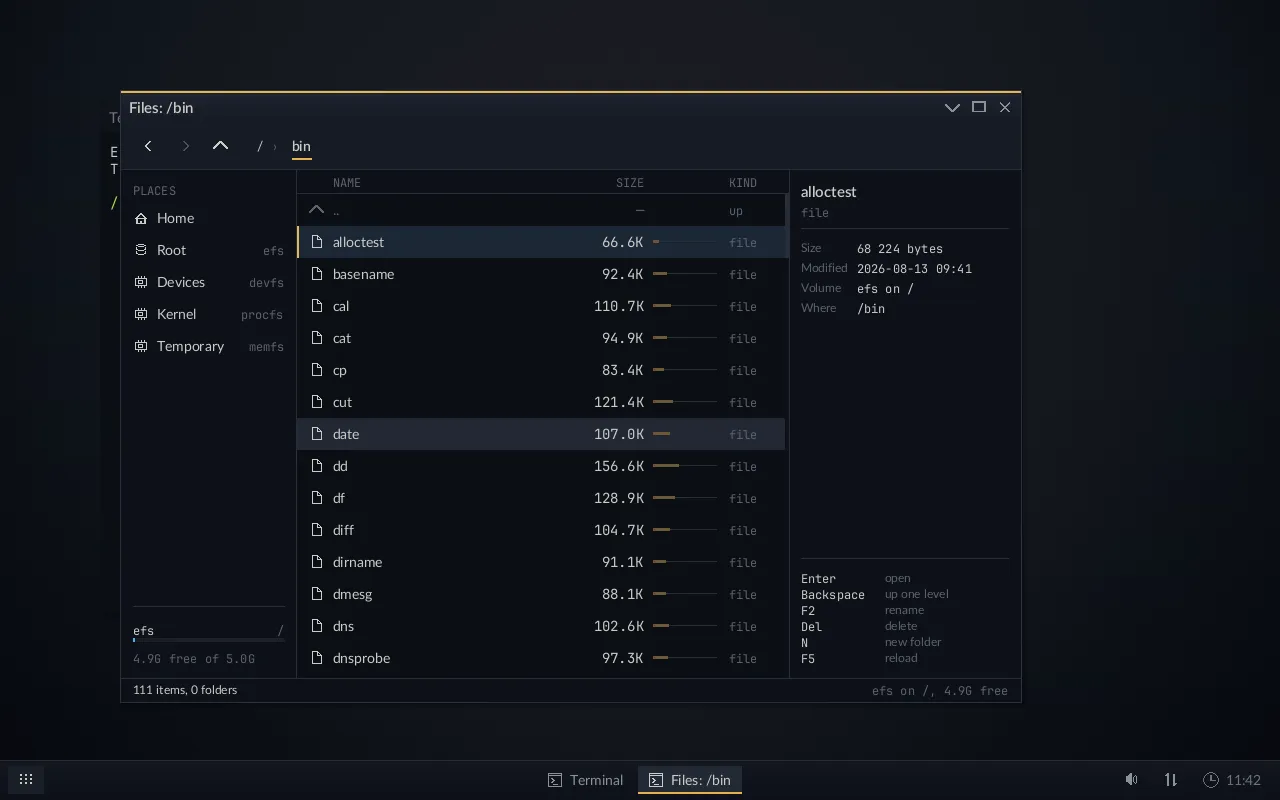
Every size carries a bar, scaled across the sizes in view rather than from zero. From zero, a directory of binaries that all sit between 66K and 157K is a column of identical bars. Scaled to what is on screen, it ranks them.
The editors
Section titled “The editors”Two, split by transport. edos-edit owns the window. edos-vi owns the terminal, and
is the only one that works over SSH.
edos-edit is graphical and non-modal: a file tree, a tab per open file, Ctrl+S. Find,
go to line, undo that takes back a word rather than a letter, and syntax colouring for
Rust, C, TOML, JSON, shell and Markdown.
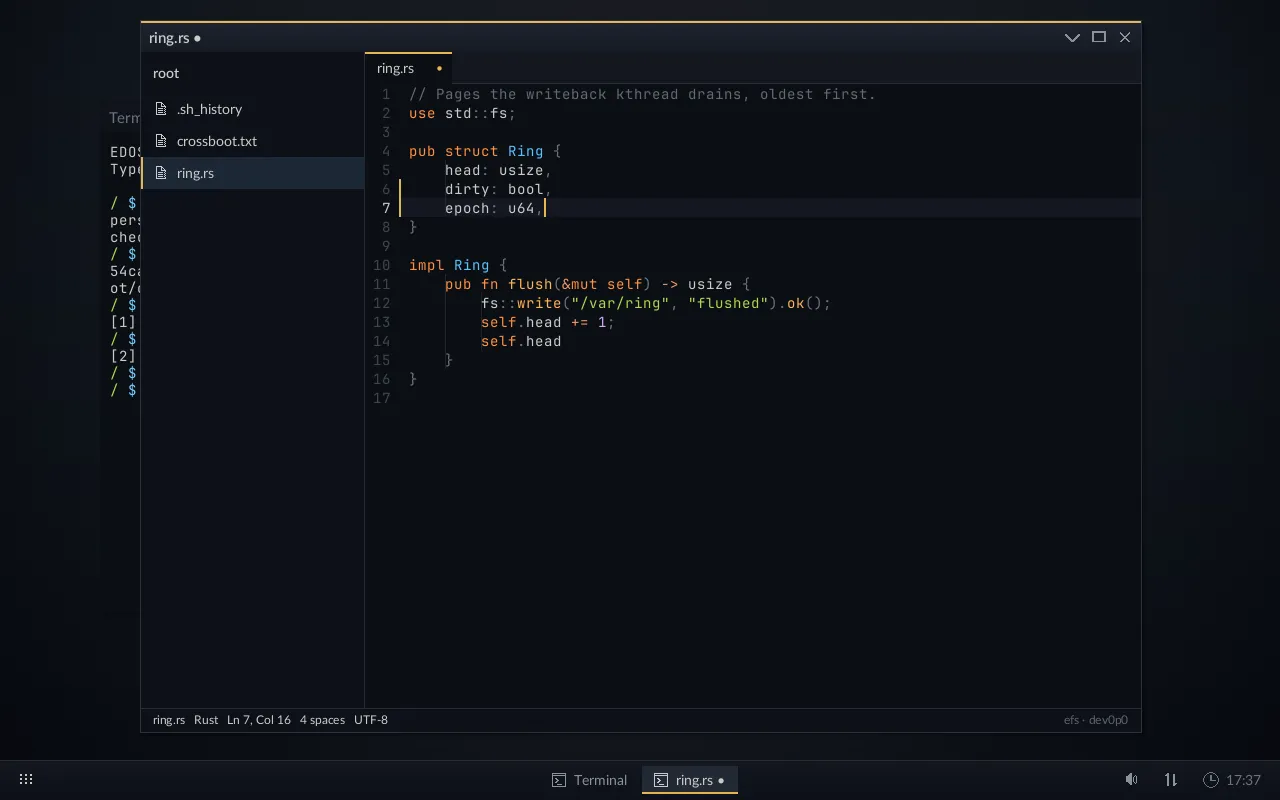
The bars in the gutter mark every line that differs from the file on disk. There is no version control on this machine, so that is the only diff you get: it shows what you have changed, before you save it.
Colours come from Ayu, the theme the rest of the desktop already uses, so a directory in the file manager and a type name in the code are the same blue.
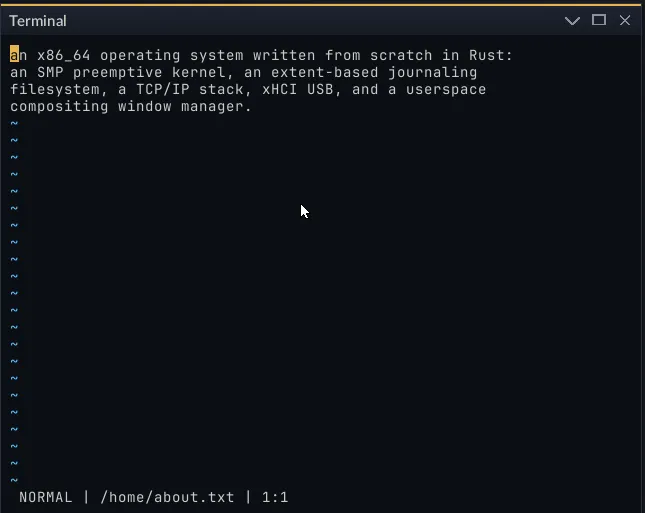
edos-vi is a vi-like modal editor: normal and insert modes, the usual motions, and
:w, :q, :q!.
Libraries
Section titled “Libraries”| Crate | What it gives you |
|---|---|
edos_lib |
syscall wrappers the fork does not surface through std: networking extras, shared memory, process control, timing, keymaps |
edos_render |
textures, a widget toolkit with layout, and the window syscalls |
edos_http |
HTTP/1.1 with TLS through rustls, and RFC 3986 URL parsing and joining |
edos_rt |
the runtime the std fork is built on, published to crates.io |
Writing one
Section titled “Writing one”See Writing a program.