
Software
EDOS installs software with grab. The repository is a handful of static files under
https://edos.edgl.dev/pkg — no API, nothing running server-side — and everything in it
is covered by one ed25519 signature.

edos-edit0.1.1editors266 KiB
Graphical text editor with a file tree, tabs and syntax highlighting
grab install edos-editWhat it writes
/bin/edos-edit/share/icons/edos-edit.svg
p/edos-edit-0.1.1.tar.gz
24870244bed1c6175590a4bfdc1055eb0f4468b4b9a5bc1de0cb0216751e2abd
Installing
Section titled “Installing”grab is on the image, so a booted system needs nothing else.
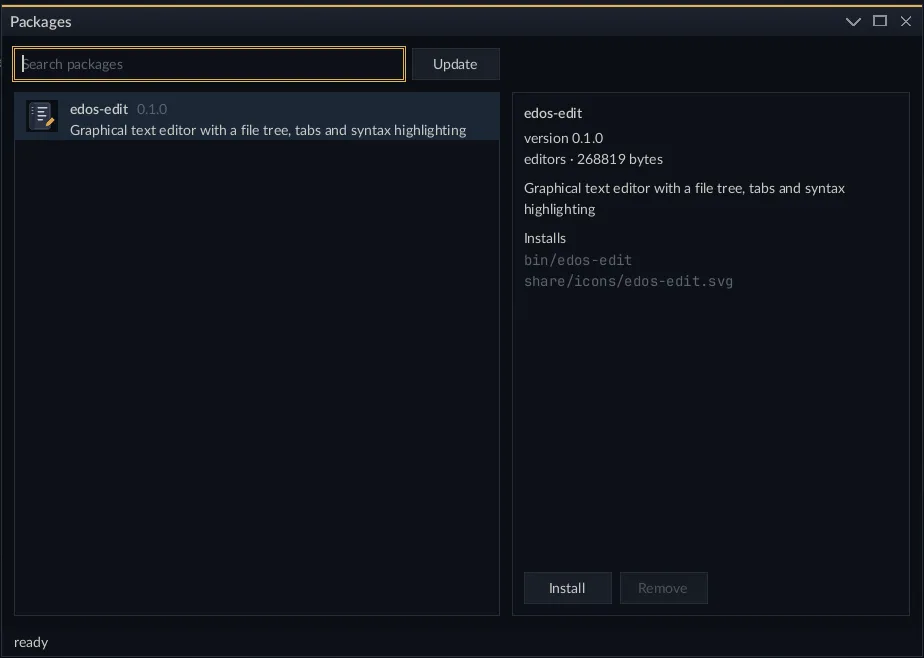
grab update # fetch and verify the indexgrab list # what the repository carriesgrab install edos-edit # download, check the hash, unpackgrab remove edos-edit # take back exactly what was recordedgrab upgrade # everything installed, to the published versionThere is a window for it too. edos-grab renders the same catalogue with its icons, and
runs every download on a worker thread so the window keeps drawing through one.
What the index is
Section titled “What the index is”RFC822-style stanzas, one blank line between them — the format the page above is rendered from.
Repo: edosSerial: 2Generated: 2026-08-13T17:21:59Z
Package: edos-editVersion: 0.1.0Summary: Graphical text editor with a file tree, tabs and syntax highlightingCategory: editorsSize: 268819SHA256: e1649498e58c4ad78cff232674976d78fba66ab15082c548abf16829e771dca5File: p/edos-edit-0.1.0.tar.gzIcon: icons/edos-edit.svgInstalls: bin/edos-edit share/icons/edos-edit.svg
Not JSON: it needs no dependency in the guest, it is greppable from a shell that already
has grep, and it reads like the rest of /etc. Serial is monotonic and is an
anti-rollback guard — grab refuses an index whose serial is lower than the one it
already holds, because a signed old index is otherwise a valid way to hide that a fixed
version exists.
What authenticates a package
Section titled “What authenticates a package”A detached ed25519 signature over the exact bytes of index, at /pkg/index.sig. The
index carries SHA256 and Size for every package, so every package’s integrity chains
from that one signature. The public key is a 32-byte constant compiled into grab.
TLS is not enough on its own, and the reason is specific: Cloudflare terminates TLS for this domain, so the certificate a guest validates is Cloudflare’s, not the project’s. Under TLS alone the CDN — and anyone who reaches the origin — decides what binaries the OS runs. Signing makes the transport untrusted, which is also what makes mirroring possible later.
TLS is still used, because a signature gives integrity and not confidentiality, and there is no reason to publish which machine installs what.
What a package may write
Section titled “What a package may write”A package is a gzipped tar of paths relative to /, and grab enforces two rules rather
than trusting the archive:
- Only
bin/,lib/,share/andopt/. Absolute paths and..components are refused.etc/is excluded deliberately: settings belong to the machine, not to a package. - Nothing may overwrite a file another package owns, and the install is recorded, so
removetakes back that list and nothing else.
A package that needs a setting to exist ships a default rather than writing one. Files
under share/defaults/ mirror the /etc tree, and an install copies each to its /etc
path where nothing is there, or where this package put the previous default there and
nobody has since changed it. Where both the default and the machine’s copy have moved,
the two are merged over the default they came from — a line merge first, then, because a
setting here is one value under its comment, a rule that says a side which changed no
value changed documentation and cannot mean anything else. What is left is a real
disagreement: the machine’s file stands and the install says so, naming where the new
default can be read. Nothing prompts, and every outcome is announced. Removal is the
mirror: a seeded file goes only while it still matches the default it came from, and one
edited since is kept and reported.
grab install --allow-unsigned ./name-version.tar.gz installs a local file with no
signature check, printing what it is about to do first. It exists so a package can be
tested before it is published, it is the only path that skips verification, and it never
applies to a URL.
Shipped versus packaged
Section titled “Shipped versus packaged”Most programs ship on the image. A program becomes a package by declaring it in the
pkg.toml beside its Cargo.toml:
summary = "Graphical text editor with a file tree, tabs and syntax highlighting"category = "editors"icon = "assets/edos-edit.svg"shipped = false # false = packaged, absent = shippedThe version is deliberately not in that file. It comes from the program’s Cargo.toml,
because two places to write a version is one place for them to disagree, and cargo’s is
the one that built the binary.
edos-edit is the first package and the reason the classification exists: it is the
graphical editor, it is the largest program in the tree, and edos-vi stays on the image
so a live session with no network still has an editor.